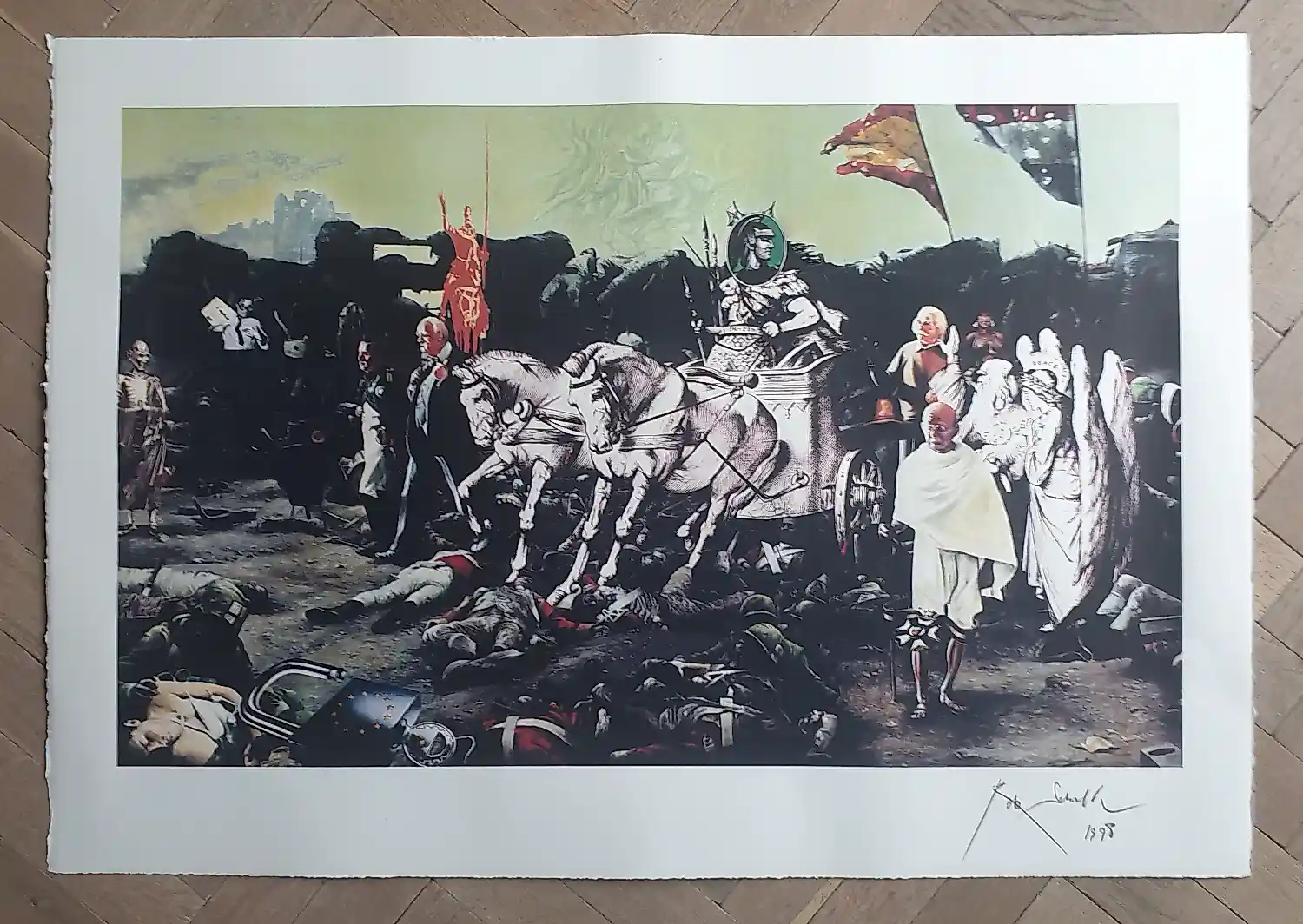
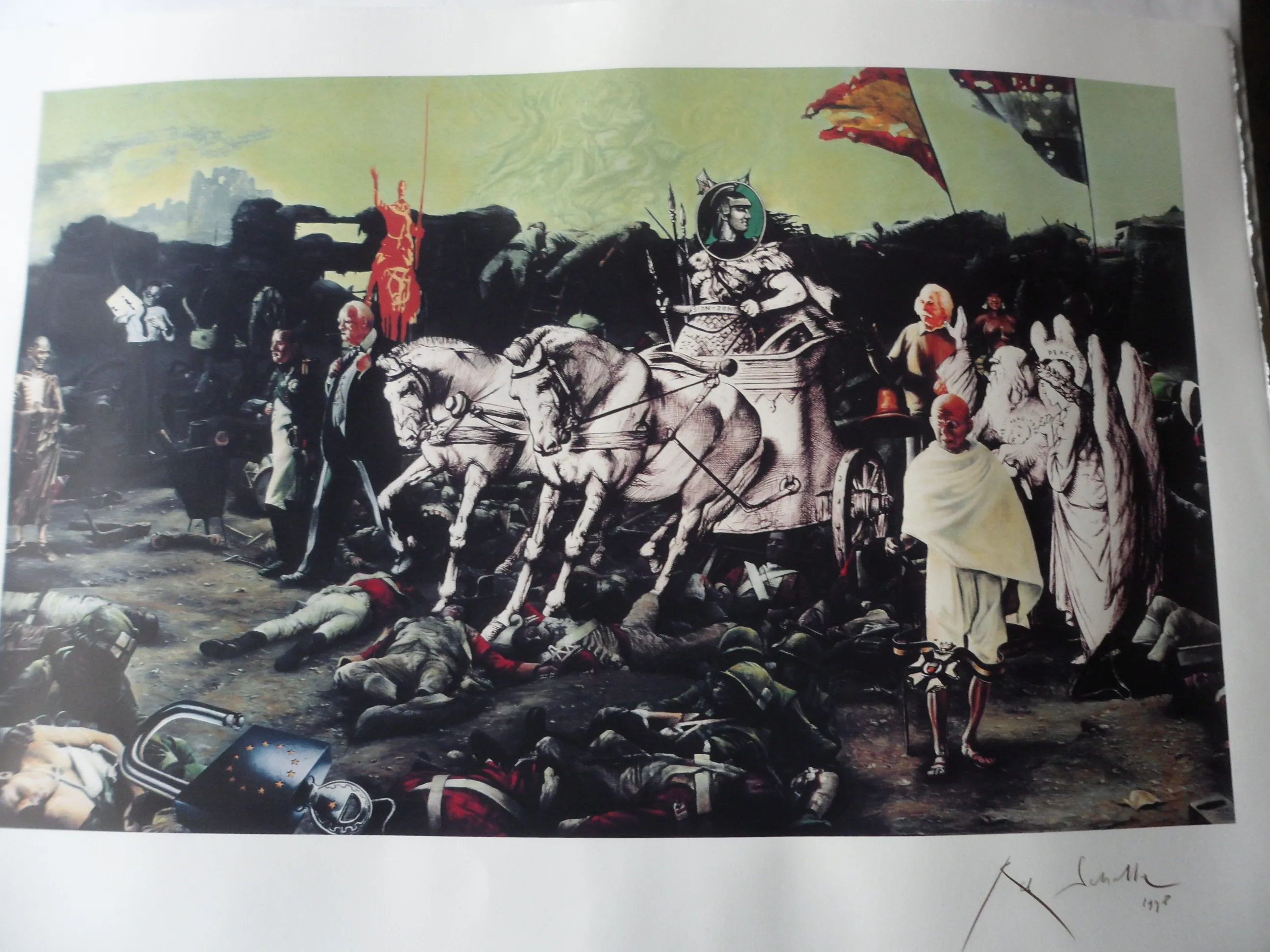
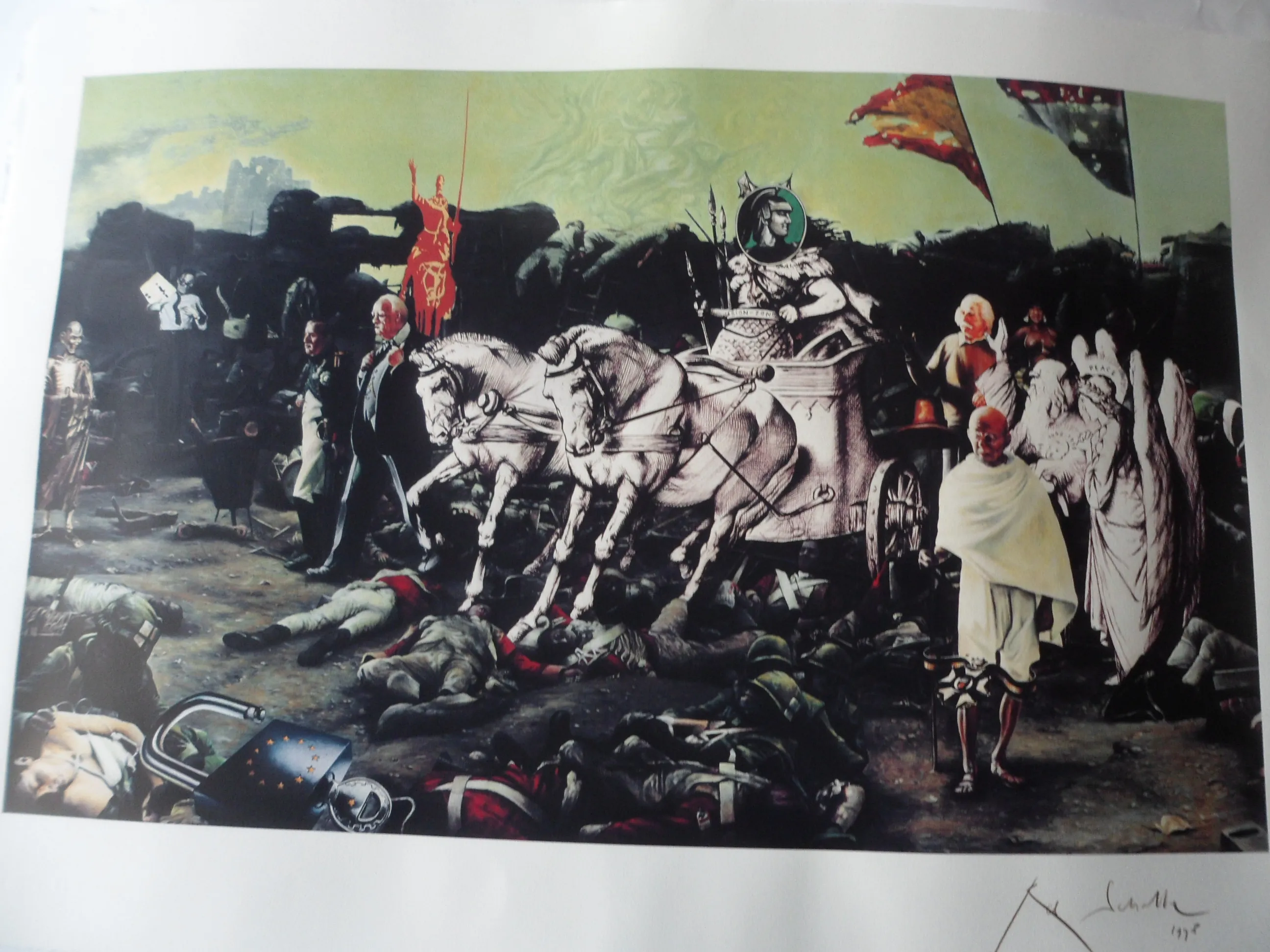
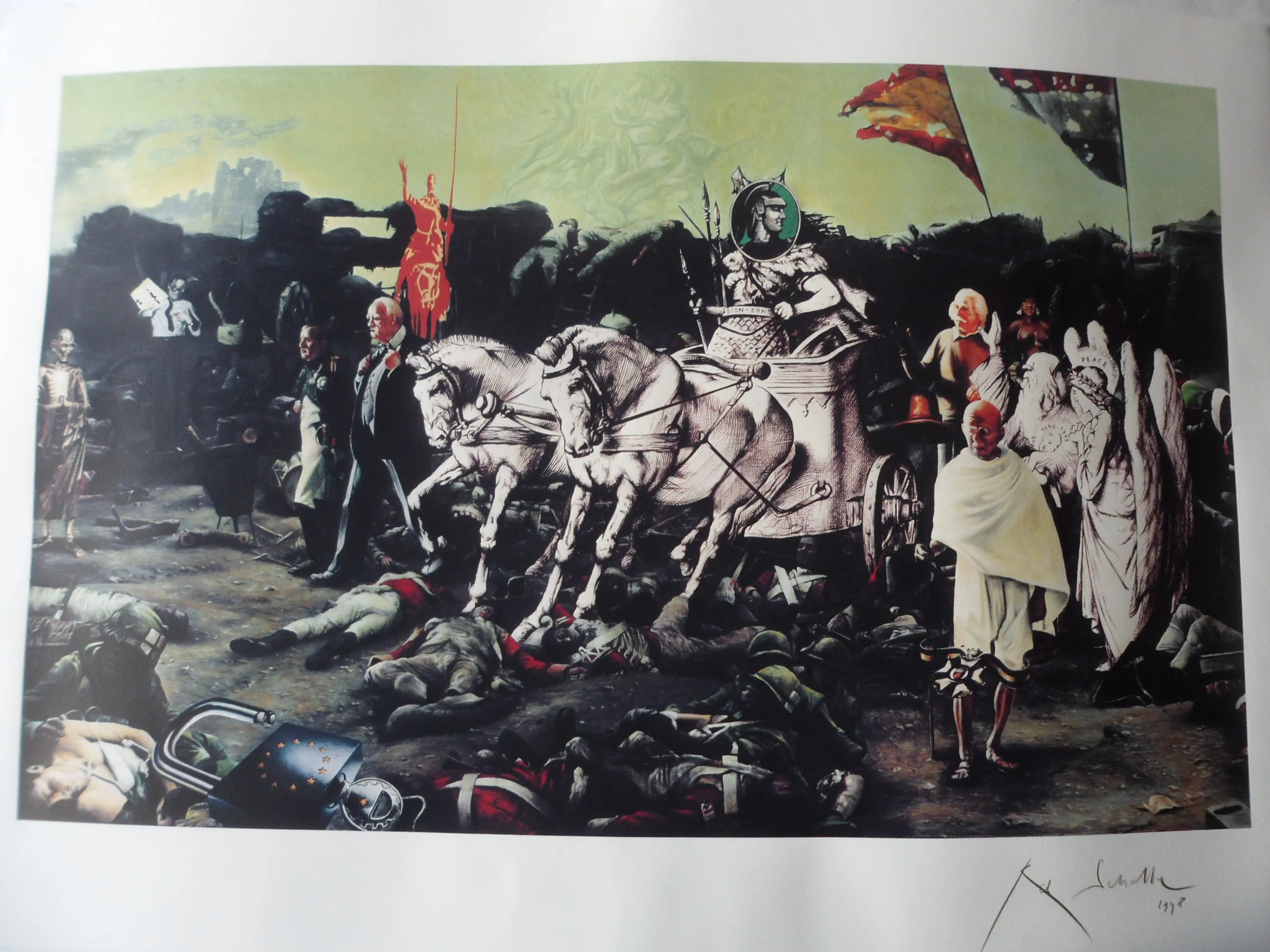
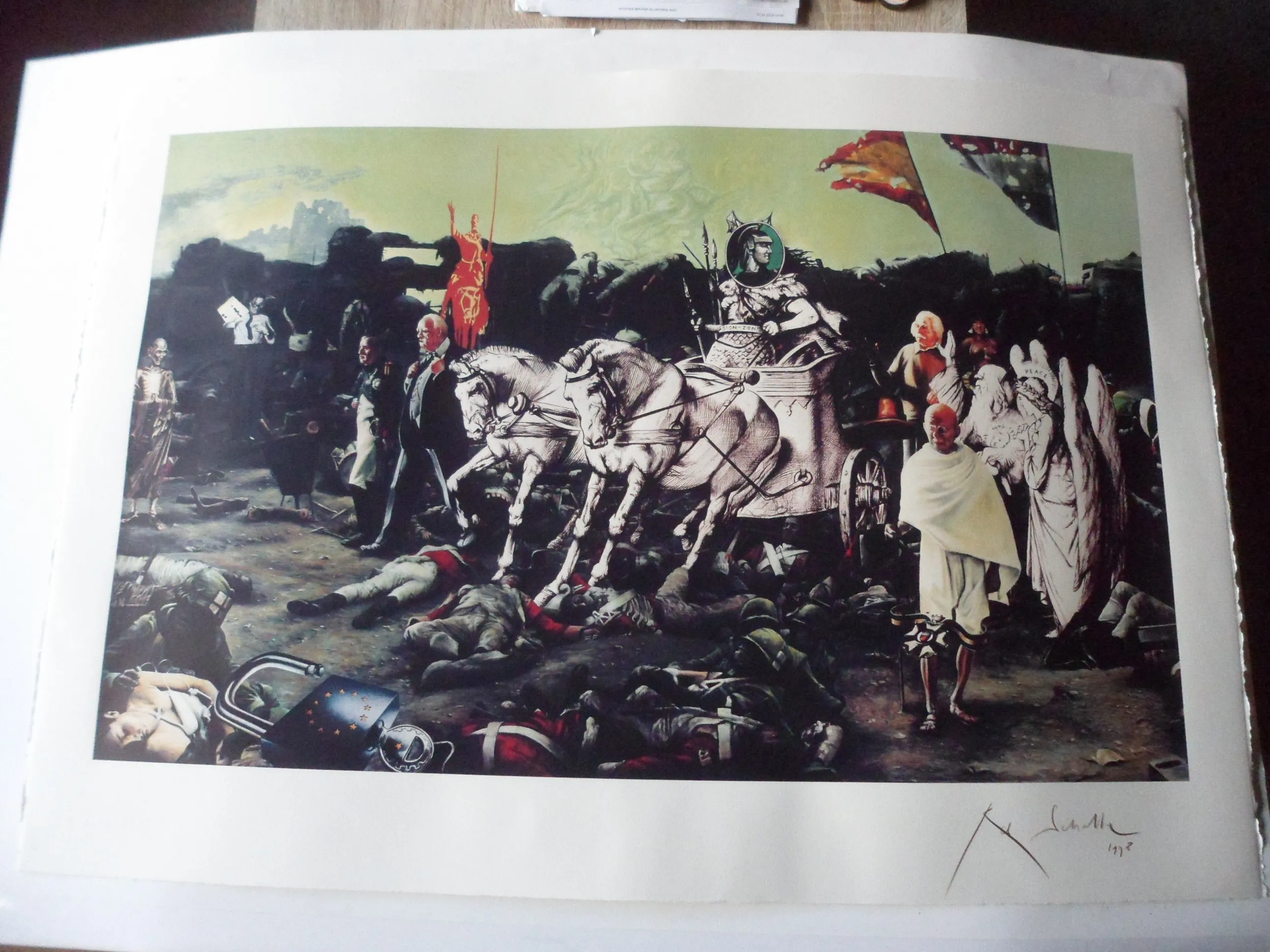
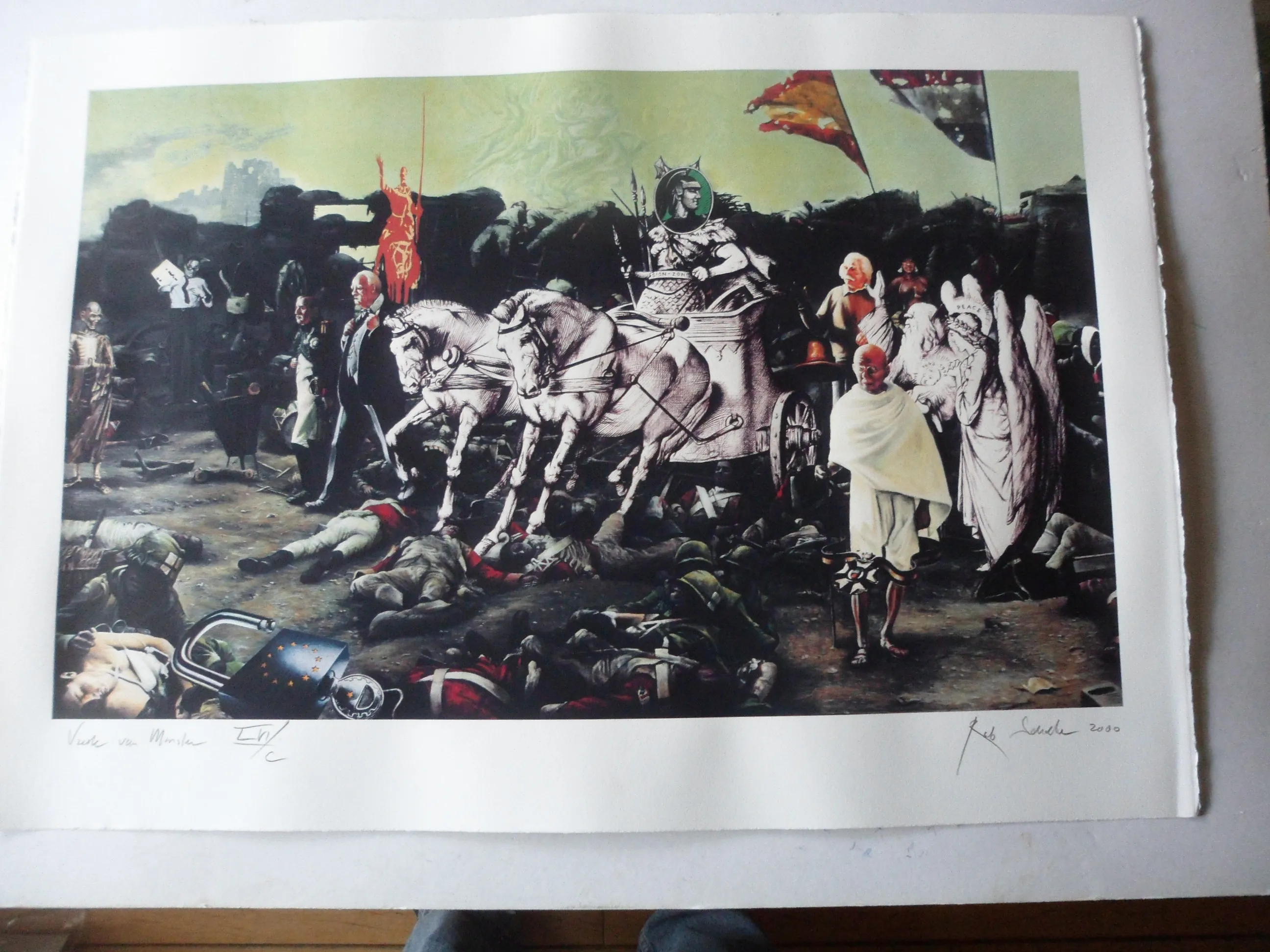
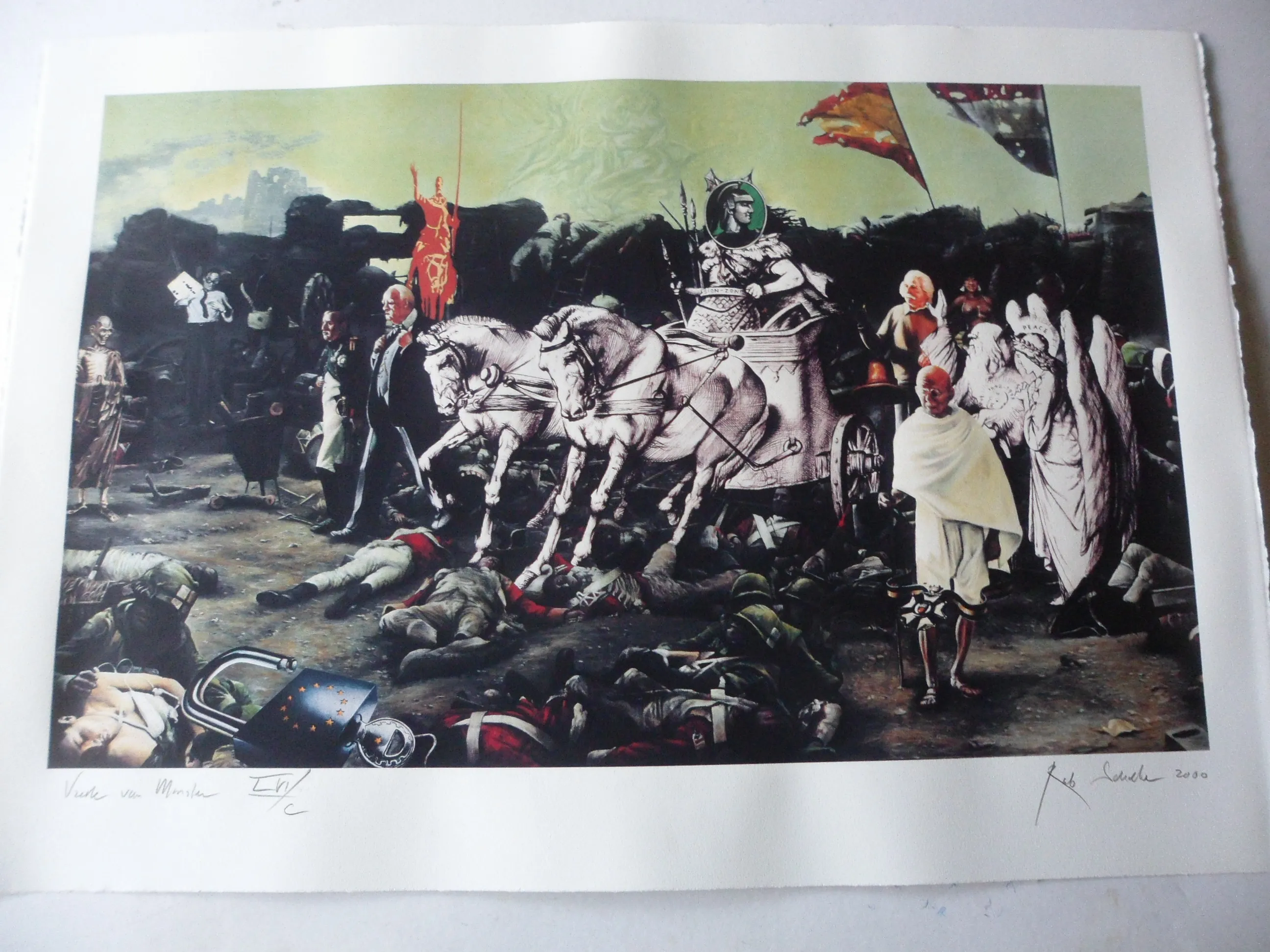
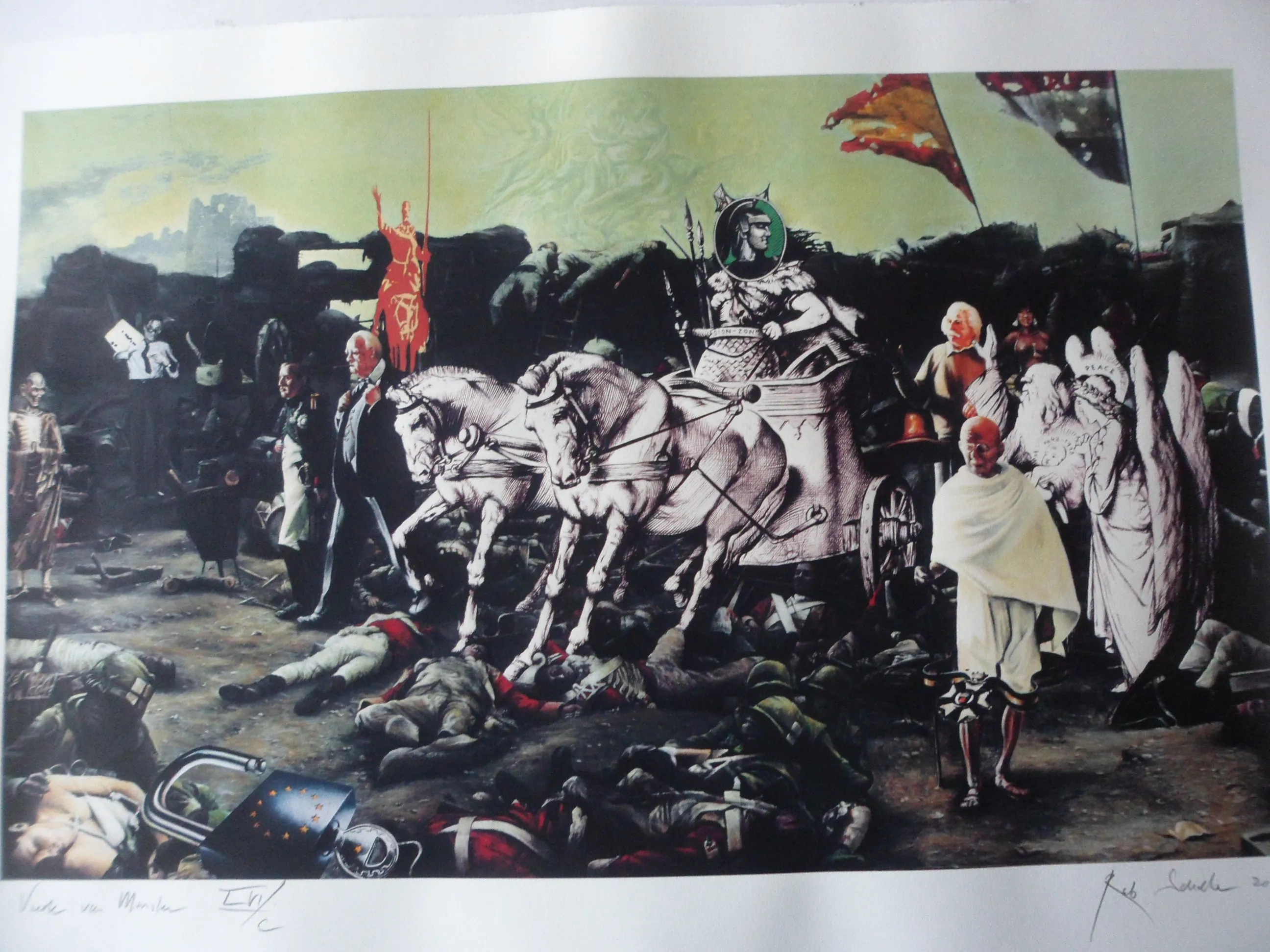
Rob Scholte - Peace of Munster

Starting bid €75
Buyer's premium : 15%
| Pick up | Yes, possible |
| Location | ALKMAAR, The Netherlands |
Auction details
| Start time | 11-10-2026 at 21:37 |
| End time | 17-10-2026 at 20:34 |
Please note: if a bid is made in the last 5 minutes, the auction will be extended by 5 minutes.
C
CGMKunst The Netherlands
2024 | |
643 sold | 19 followers |
- Description
- Rob Scholte (1958)
| Type of artwork | Prints (signed) |
| Year | 2000 |
| Technique | Lithograph |
| Support | Paper |
| Style | Modern |
| Subject | Figures |
| Framed | Not framed |
| Dimensions | 63 x 91 cm (h x w) |
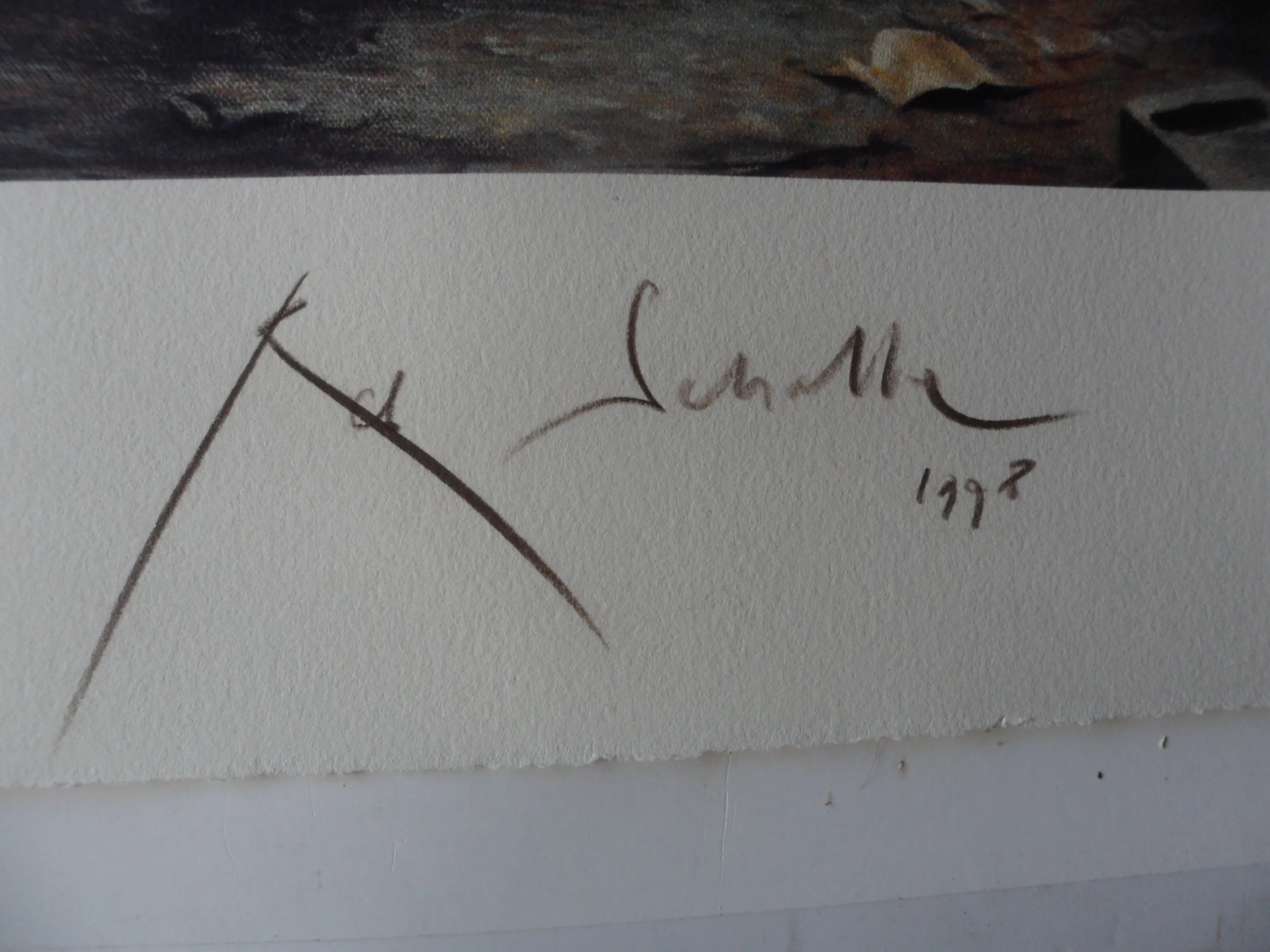
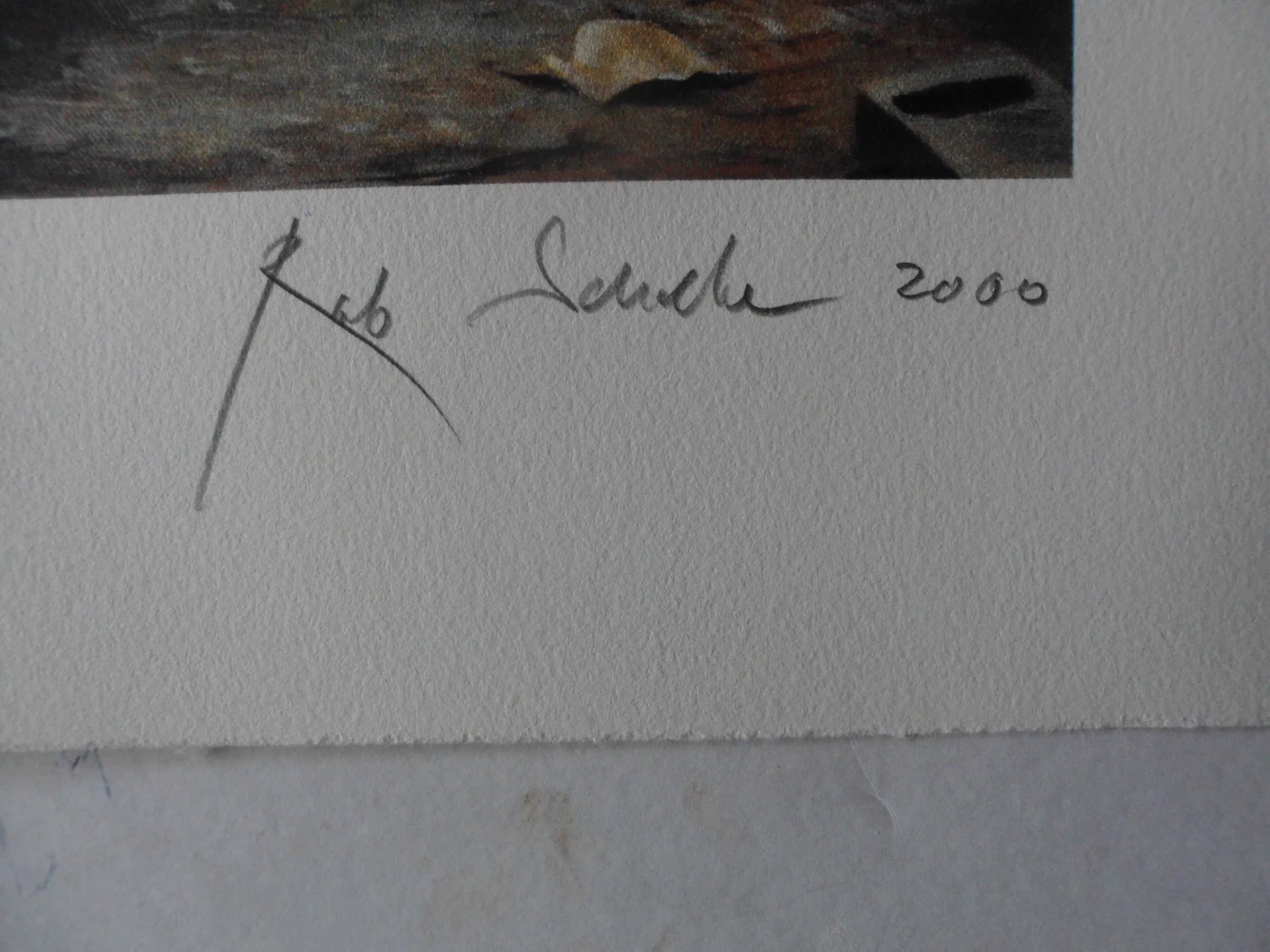
| Signed | Hand signed |
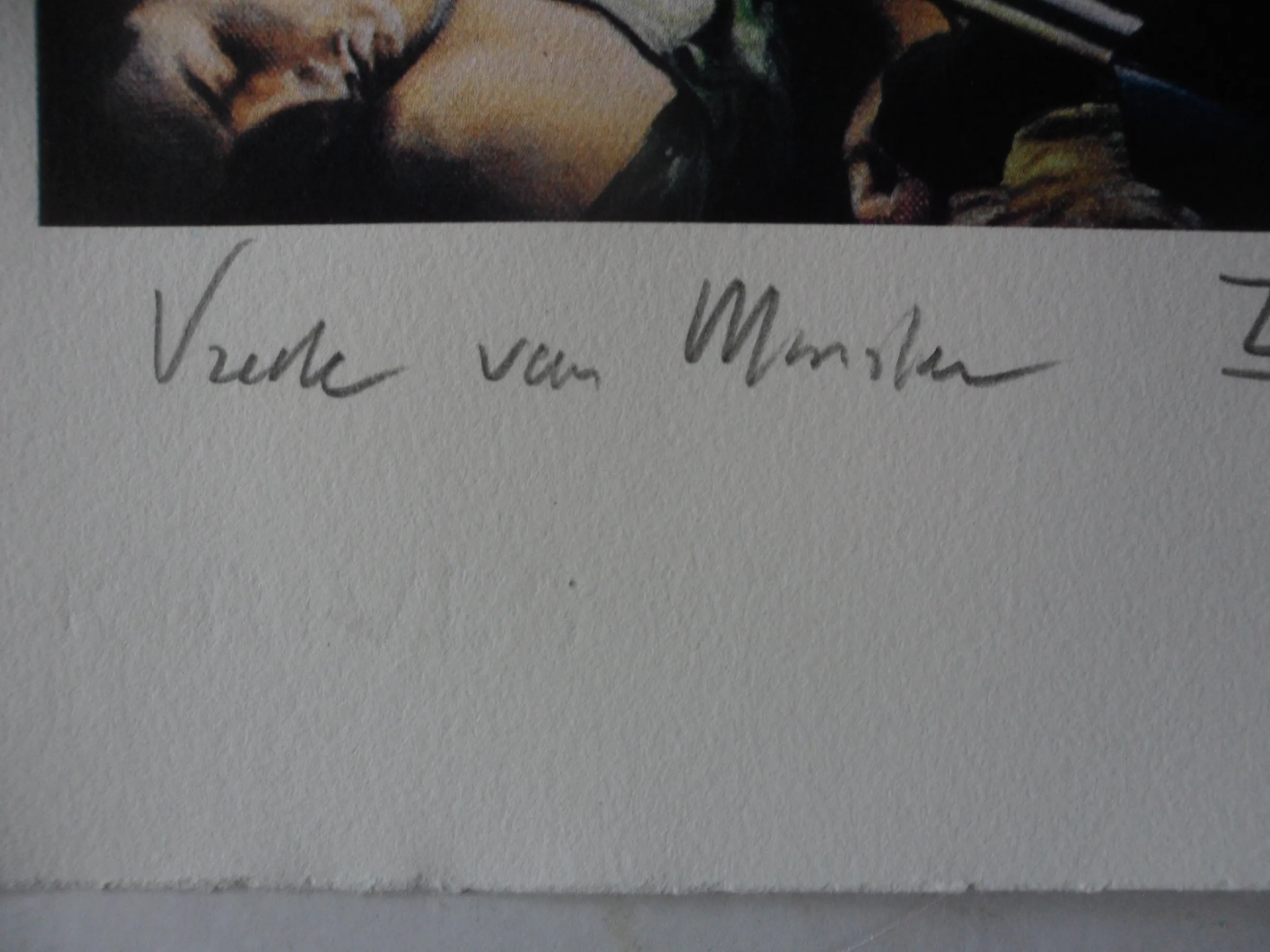
| Edition | LXXXVI/C. |
Translated with Google Translate. Original text show .
Screen print by Rob Scholte. "Peace of Münster" (2000) Edition size may differ from the photos. Rob Scholte does not want to be an artist who engages in deeply felt, strongly personal expression in the isolation of his studio. In his view, art must convey a message. His art has the visual power of a billboard along a highway. It appeals directly, yet is the opposite of superficial. His art is layered by personal interpretation, humor, intelligence, and expertise. And although his paintings give the impression of having arisen spontaneously, nothing could be further from the truth. Rob Scholte (Amsterdam, 1958) Scholte lived in Castricum, Doorn, Heiloo, and Egmond aan den Hoef. From 1977 to 1982, he studied at the Gerrit Rietveld Academy. Subsequently, he was part of the artist collective W139, among others, where he debuted with Sandra Derks in 1982 with the 'masterpiece' Rom 87, a series of variations on a children's coloring book painted in a free style. He would replace this style with meticulously painted works, which he began exhibiting in 1984 at The Living Room. Works by Scholte were shown at Documenta in 1987, and in 1990 he was commissioned to design the Dutch pavilion at the Venice Biennale. In 1986, he caused a stir with a painted reproduction of a postcard, Utopia (Museum Boijmans Van Beuningen). When it was pointed out that this was a quote from Manet's Olympia, Scholte responded with a painting in which the newspaper article containing this criticism and image was supposedly reproduced; a literal quote of half a newspaper page. With *How to Star*, a solo exhibition at Boijmans Van Beuningen featuring paintings from 1983–1988, Scholte received both praise and criticism. In 1991, he met the model, soap opera and film star, Micky Hoogendijk. She became director of his BV, and on May 31, 1994, they married at the house temple the RoXY. In 1993, Scholte became a lecturer at the Kassel Academy of Fine Arts, a job he would resign in 1999. In 1991, Rob Scholte BV secured the commission for a 1,200-square-meter wall and ceiling mural at the Huis Ten Bosch Resort in Nagasaki, Japan. Scholte worked with a large number of assistants on the painting titled *Après nous le déluge*, about the continuous recurrence of war in history. Its opening was scheduled to take place on August 9, 1995, coinciding with the 50th anniversary of the atomic bombing of Nagasaki, but had to be postponed due to an attack on Scholte. Scholte is an image maker. He arranges and places images—from the mass media, from his own extensive archive—in a new context, thereby imbuing those images with new meaning. Often, one finds contradictions and oppositions in his works that are 'overcome' in their new context. The meticulously painted works by his hand are usually produced by assistants and signed by himself. In doing so, he follows a 17th-century method of working. His working method is illustrative of postmodernism and emphasizes the permanent influx of images that surround, shape, and mold us. The media are always thematic; he draws inspiration from them, criticizes their manipulation, and has also acted as a 'media personality' himself.
| Condition | |||||||||
| Condition | Very good | ||||||||
| Shipment | |||||||||
| Pick up | The work can be picked up on location. As a buyer you must bring your own packaging materials. The location is: Alkmaar, The Netherlands | ||||||||
| Shipment | Parcel post | ||||||||
| Price | Up to 5 kg.
| ||||||||
| Guarantee | |||||||||
| Guarantee | By putting the item up for auction, I agree with the Terms of Guarantee as they are applicable at Kunstveiling regarding the accuracy of the description of the item | ||||||||
| Consumer law | This seller has indicated that they are a private seller. Therefore, consumer law does not apply. Read more | ||||||||
The seller takes full responsibility for this item. Artpeers only provides the platform to facilitate this transaction, which has to be settled directly with the seller. More information .
Rob Scholte (1958)
 Dutch
Dutch C
CGMKunst The Netherlands
2024 | |
643 sold | 19 followers |
91 cm
63 cm